

Outsourced Philippines guide
Build a Device Return Chain for Philippines Remote Work
A practical Philippines outsourcing guide for remote device return coordination, with source evidence, least-privilege access, exception ownership, measurable review, and a clear decision boundary.
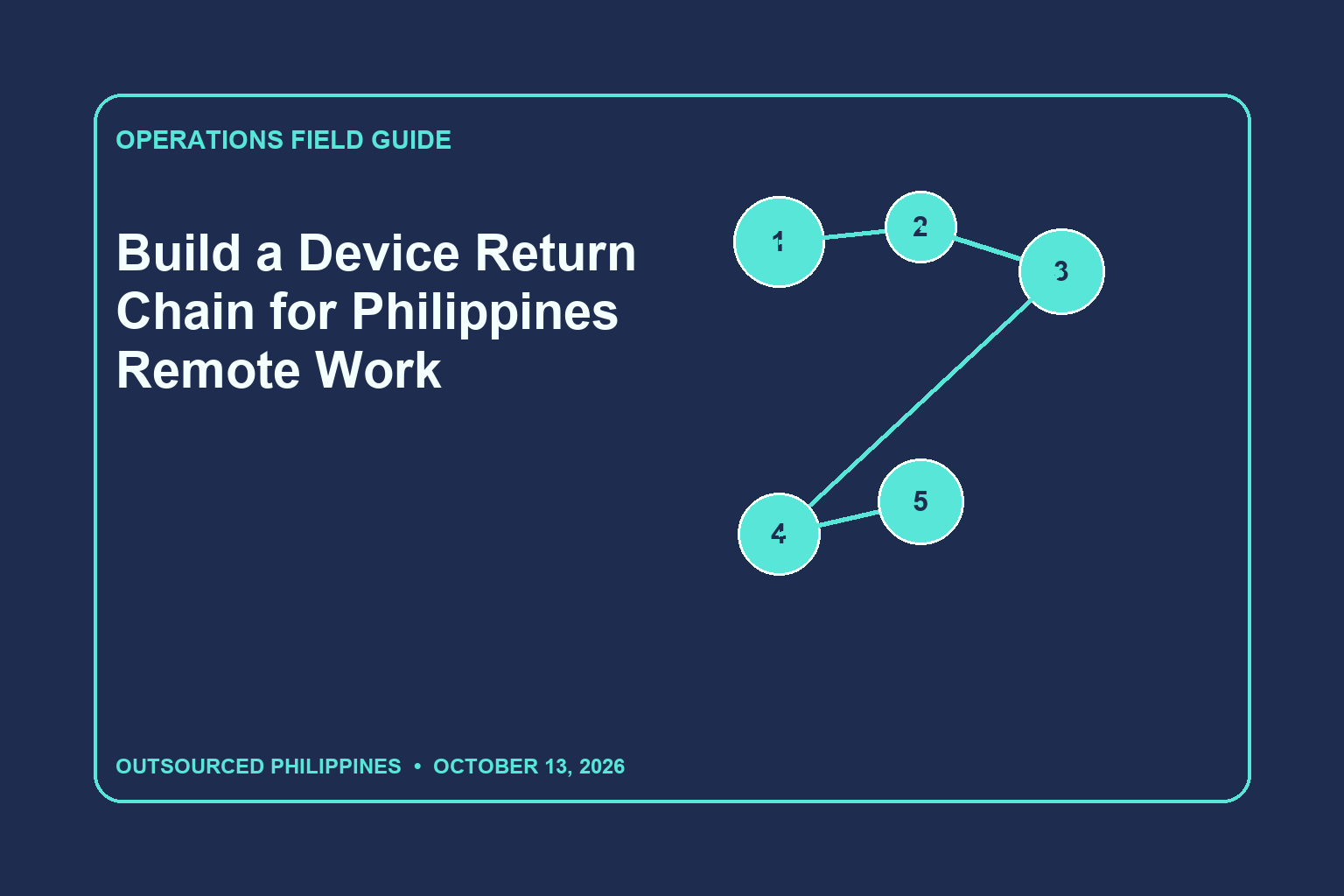
Use this remote device return coordination workflow to make the operating boundary visible before volume grows. The company owner retains consequential decisions while Philippines-based support prepares evidence and routes exceptions.
Define the work unit and readiness gate
Define remote device return coordination as a bounded support lane before work moves to a Philippines-based team. The unit is one assigned device traced from return instruction through custody events to verified destination receipt. Name the system of record, observation window, service window, review owner, and decisions the evidence may support. This prevents administrative preparation from quietly acquiring consequential authority.
Require asset register, assigned user, approved shipping route, packaging rules, access-removal owner, destination, and deadlines before a remote device return coordination item enters the ready queue. Missing inputs receive a reason code, return owner, and safe holding state. Support staff may locate facts and prepare a question, but they should not invent the missing condition to satisfy a deadline.
Questions to settle
- Is one assigned device traced from return instruction through custody events to verified destination receipt the declared unit?
- Are missing inputs held with an owner?
Specify completion and preserve source history
Write completion for remote device return coordination in terms of asset ID, instruction, courier record, custody events, receipt, condition, access status, reviewer, and closure. An item is not complete merely because a message was sent or a field was updated. The reviewer must be able to connect the source, instruction, actor, and destination state.
Preserve the original source and every material correction for each one assigned device traced from return instruction through custody events to verified destination receipt. Record effective dates and version changes rather than overwriting history. A clean final record should not conceal the uncertainty, exception, or reviewer decision that produced it.
Questions to settle
- Can a reviewer trace source to destination?
- Are corrections and effective dates preserved?
Test adverse cases and independent review
Rehearse an ordinary case plus lost device, damaged seal, personal data, disputed assignment, cross-border shipping restriction, or security incident. Stop when evidence, identity, authority, or the controlling rule is absent. Urgency does not authorize broader access, a fabricated source, or an unsupported customer, financial, legal, safety, or personnel decision.
Design review around the central risk: marking an asset returned before custody, destination, data, and access states are reconciled. A second reviewer should reconstruct one accepted and one held case from the source trail. If private explanation is required, repair the checklist, source link, or ownership map before adding volume.
Questions to settle
- Does the lane stop on lost device, damaged seal, personal data, disputed assignment, cross-border shipping restriction, or security incident?
- Can another reviewer reproduce a held case?
Limit access and protect information
Use named accounts and the least access needed for remote device return coordination. Record the business purpose, approver, grant, expiry, and removal check. Separate view, prepare, submit, approve, pay, publish, and administer permissions instead of treating application access as one indivisible role.
Protect personal, commercial, and operational data in the remote device return coordination queue. Minimize exported fields, restrict links and downloads, use stable case keys where identity is unnecessary, and define retention before launch. A convenience copy can become an unmanaged second system of record.
Questions to settle
- Are permissions separated by action?
- Are exports and retention bounded?
Route exceptions and measure honest outcomes
Give each exception an owner, response window, and safe interim state. If the owner is unavailable, keep the one assigned device traced from return instruction through custody events to verified destination receipt held unless an approved alternate has equivalent authority. Track owner wait separately from active handling so an appropriate stop does not appear as poor support performance.
Measure eligible one assigned device traced from return instruction through custody events to verified destination receipt records, accepted outcomes, corrections, correct stops, reopened items, missing evidence, and wait time by owner. Report denominators and exclusions. A favorable average cannot erase a serious adverse case or work displaced to another queue.
Questions to settle
- Does every exception have an authorized owner?
- Do measures retain denominators and exclusions?
Sample risk and verify closure
Sample early remote device return coordination work at one hundred percent, then use risk-based sampling only after ordinary and adverse cases behave consistently. Continue full review for changed rules, new systems, sensitive records, prior failures, and rare high-impact exceptions.
Close each remote device return coordination item by reconciling source state, queue state, destination state, communications, temporary access, downloaded files, and outstanding owner actions. A local status of done is weaker than evidence that the accountable destination accepted the result.
Questions to settle
- Are changed and sensitive cases fully reviewed?
- Does destination evidence support closure?
Repair the system before expanding
Use recurring remote device return coordination findings to repair the brief rather than repeatedly coaching around a broken input. Classify whether each finding came from unclear instruction, missing source, tool limitation, access failure, staff error, owner delay, or genuine judgment, then assign the corrective action to the owner of that cause.
The intended result is a custody trail that coordinates logistics while security and asset owners retain decisions. Expand the Philippines support lane only after representative cases can be reconstructed from intake through acceptance. Reopen the design after a material change in system, data, authority, owner, service window, or risk.
Questions to settle
- Is each repeat issue assigned to its actual cause?
- Will a material change reopen the design?
Sources and next steps
Continue with Philippines operations support, then confirm scope, authority, and review ownership before expanding the role.